John Q is one of those movies that gets you to think and to ponder; not about the intricacies of the plot itself, but upon the problems and ironies that exist in our society today. This movie seems to take the frustration and rage within writer James Kearns and personify it into the title character, John Q. Archibald (played marvelously by the legendary Denzel Washington).
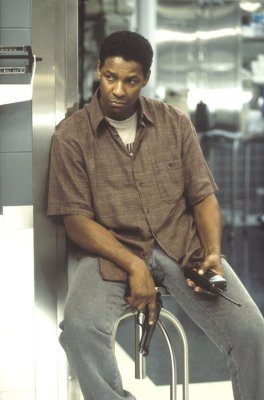
John is a simple factory worker who toils hard for his family, and things are getting harder now that his factory has reduced his hours from 40 to 20 hours per week. Bills are piling up, but he is still able to lead and to provide with dignity and grace. However, after his son collapses on the baseball field and the hospital tells him that his insurance will not cover a much-needed heart transplant for his son, John and his wife soon find themselves running out of options (James Woods is the seemingly cold-hearted heart surgeon - what a pun!). They try selling their possessions, fund-raisers, church donations...anything they can do to raise the needed $30,000 just to get their son's name on the donor waiting list. They also wait in lines, apply for government aid, and appeal to the insurance company. Unfortunately, all of these avenues are a dead end.
Eventually, the hospital moves to release young Michael and John is faced with the harsh reality of watching his son die. In a pivotal and emotional scene, his wife calls him and tearfully demands, "DO SOMETHING!" Then the question comes, as a father in such a situation, what would you do?
John Q decides to take matters into his own hands. He takes a gun to the hospital, quarantines the emergency room, and takes everyone inside as his hostage. He then begins to demand that his son be put on the heart donor waiting list.
The rest of the film explores the possibilities (or one such possibility) of what might happen in such a situation. We see things from the side of the hostages who are patients, nurses, and doctors. We see things from the side of the police and the FBI. Chief among them are the negotiator, Grimes (played by Robert Duvall who is always entertaining, especially here), and the chief of police, Monroe (Ray Liotta). Duvall's character seems sympathetic to John Q, while Monroe's main concern is for order and the image of the police in the eyes of Chicago citizens. And then there is the media who seems to think of nothing but profit from the calamity.
This movie did several things right. First of all, it gave us an outlandish set of events which seem altogether possible. Here the film really did cover all of the bases in quieting all of the "Yeah, but..."'s. Secondly, the casting of Denzel Washington and Robert Duvall were perfect choices. They both gave excellent performances. Finally, the movie did a decent job of getting its point across on a variety of topics such as health care, insurance companies, welfare, politics, and the media.
However, in a few pieces of the film, I was personally offended. It seemed that the movie went a bit too far in certain areas which insulted my intelligence as an observer. First and foremost, the movie bent over backwards to exonerate and to glorify the main character, John, in what was essentially a criminal act. He really comes out looking like a saint and a martyr. Conversely, it almost demonizes hospitals, insurance companies, and the government. For instance, there are several scenes in which John and his wife talk to various clerks and officials asking for help, only to be rejected with the most cold, unfeeling, and antipathetic demeanors that you could imagine. Anne Heche's character, the hospital administrator, almost seemed like Satan herself. But even more disturbing was the last 2 minutes or so of the movie (which should have been left out, in my opinion). Here we are given a 2 minute commercial promoting liberal viewpoints from the likes of Hillary Clinton, Jesse Jackson, and Bill Maher. Rather than let the audience form their own opinion on what was just seen, we are spoon-fed as if we are two-year-olds.

All in all, however, I do like and recommend this film because of the question that it asks. As a father myself, I am so thankful that I have not been put in the position that John Q. Archibald found himself, and I am not quite certain what I would do were I in that same position. It is easy enough to sit back and to promote lawful order and ethical conduct when it is not your own kid's life on the line. It is something quite different when doing so (or doing nothing) would mean the death of your own child. How far would you be willing to go for your children? What lines would you cross?
 See this movie. Feel the struggle. Experience the absurdity of the situation. Debate with your friends.


 Read
Read




 Back
Back