I'll have to admit that I never really knew all that much about Howard Hughes, the eccentric tycoon who rammed his way into the movie and airline industries. All I had ever really heard was that just before his death he lived as a recluse, with shriveled body, unkempt hair, and uncut fingernails. It was not a flattering impression, to be sure.
Martin Scorsese's The Aviator takes us back, into the life of the high-flying Hughes, showing us a young man with vision, talent, and a disregard for convention and the status quo. It is a brilliant film with a captivating story and superb acting. However, even more remarkable is the fact that this movie takes us inside this gifted and troubled mind. This contrasts so much from other biographical film failures, in my opinion, such as Ray and Ali, because in this movie when we see a crazy decision being made, we understand why. Instead of being outside observers, we feel connected. We understand that at the start of his movie-making career that Howard Hughes was an outsider, determined to do what had never been done before which explains his disregard for traditional Hollywood studios and their methods. We understand his fear of disease and his discomfort in large crowds which stem back all the way from his childhood and the cholera epidemic. We also understand how his money, power, and independence allowed and even fueled the extremity of his mental breakdowns. There is also a sense of respect and admiration; even in his troubled breakdowns the film treats him with care and understanding. Again, this movie is simply an extraordinary accomplishment in that it communicates something so strange and complex as the life of Howard Hughes so effectively.
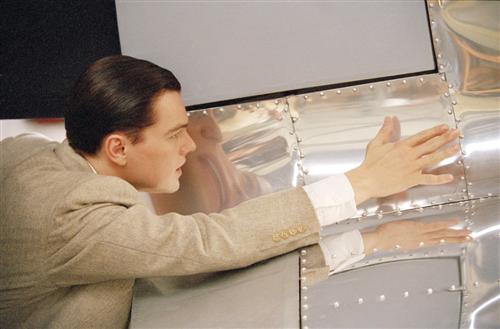
Aside from John Logan's script and Scorsese's direction, the real core of this film lies in the performance of Leonardo Di Caprio. When we first see him, he is cocky and brazen on the set of Hell's Angels, a movie which Hughes wrote/produced/directed and which at $3.8 million was the most expensive movie ever made. Yet, though Hughes was made powerful through the inheritance of his parents' oil drill-bit tool company, Di Caprio is able to tell us that he is still a kid and may be a bit unsure of himself on the inside. After the huge success of Hell's Angels we see his confidence grow as he next begins fueling his passion for aviation. A mechanical genius, we see him take charge of the design-work on experimental aircraft, pushing his hired engineers to their limits. However, it isn't until his romances with Katharine Hepburn (Cate Blanchett - below, left) and Eva Gardner (Kate Beckinsale - below, right) that we see his inner-most vulnerabilities come to the surface. Di Caprio takes Hughes from a brash, brazen, and unstoppable dreamer, to a suffering, self-destructive hermit, and back again. The best piece scene in the film, in my opinion, involves Hughes fighting his way back to sanity during a conversation with Juan Trippe, the head of Pan Am, who sits on the other side of a closed door. Di Caprio seizes his mouth with both hands to avoid repeating himself over and over again as happens during his breakdowns. There is a look of desperation and fear in his eyes along with his trembling, clenched hands; yet we also see a fierce determination to be "normal." I was impressed.


Hughes' relationships with Katharine Hepburn and Eva Gardner are just two of many such relationships but are displayed here as having great significance. Of the two, Blanchett's performance is the most remarkable as Katharine Hepburn. Her accent is great and we see her character vacillate between reclusive companion to Hughes and a socialite.
I was also quite impressed with Alan Alda as Senator Brewster, who goes after Hughes in a Senate investigation and winds up having the tables turned a bit and being grilled by the recovered and lucid Hughes. Alda's character has some depth to him as well including a questionable relationship with Pan Am chief Juan Trippe (played by Alec Baldwin, who is increasingly filling roles of men we love to hate).

As I left to the theater, I felt three primary emotions. The first was sadness. It is sad to see a brilliant mind so afflicted by mental illness. I also had the sense that Hughes would have been so much better off if he had a loving woman to care for him and to keep him steady and stable: a role which Katharine Hepburn played for him early in his life and a role which Eva Gardner later refused to fill. I also felt admiration, for this man did accomplish and overcome so much in his life that pity seems a bit out of place. And finally, I felt curiosity. I had just had a small taste, a brief glimpse into this man's life, and I wanted to know more (the movie does not take us through the entire life of Howard Hughes but instead focuses on the period from the mid-1920's when Hughes was in his early twenties, with the filming of Hell's Angels, to the flying of the "Spruce Goose" in late 1947 when Hughes was 42).
And so The Aviator gives much to its viewer. Aside from telling a great story about a remarkable and troubled life, there are flashes of excitement, moments of romance, and sprinkles of humor. I highly recommend this film; however, I must give one caveat. I don't believe that this will be one of those movies which we'll want to watch over and over again, but perhaps you can be the judge of that.
 An extraordinary accomplishment in film; however, it is probably not going to be one that you'll want to watch over and over again.



 Read
Read


 Back
Back